All posts by T. A. Myron

Chapter Seven – Changes

Dilmir did not learn what fate had befallen Alfimir until the following morning. Elmir, breaking his usual code of silence, informed him that Alfimir had been sentenced life-long banishment from Eld’rin and the laws of the elves. He now had as much status among them as a beast of the forest, albeit a very powerful one. The news troubled Dilmir. He knew that Alfimir would not be permitted to set foot again in Eld’rin, but he still could not see why he had attacked him in the first place. Now that he was no longer subject to the laws of the elves, he could very easily attempt to kill him again.

“Focus, Dilmir,” said Elmir dryly. Dilmir wrenched his mind from his thoughts and turned them instead to the flame he was supposed to be conjuring. It was not proving as easy as Alfimir had made it look the night before. In order for the flame to last any amount of time, it needed something to burn. Nearly anything would suffice, as magic could easily ignite it. Once a flame was born, Dilmir was supposed to expand it and fling it at Elmir, who would block it. Getting the piece of earth he was using to ignite was proving troublesome however. The brown speck simply sat in his hand, a little warm, but far from bursting into flames. Dilmir automatically glanced sideways to see if Ilrin had mastered the spell yet, forgetting temporarily that she was not there.

She had met him in the morning as usual, only to hurriedly tell him that she had been called before the council to explain what had happened last night. She had been gone for nearly five hours already, and Dilmir couldn’t see what could be taking her so long.

Her absence was proving to have unexpected effects. Her trainer, a young elf woman by the name of Iliadin, was passing the time by watching Dilmir and Elmir train. She wasn’t the only one, either. News of last night seemed to have spread uncommonly fast, so that many elves were looking in Dilmir’s direction. Between that, and Alfimir’s ominous statement of the night before, he was finding it difficult to concentrate.

Just as he was beginning to think that Ilrin must have gone home, rather than pick up her training when it was almost finished, she appeared in the gateway, walking quickly towards Iliadin, who rose when she saw her. The two of them conversed for a moment, though Dilmir could not hear what was said, and then split apart, evidently preparing to train.

All thoughts were forced from Dilmir’s mind as the speck of dirt in his hand suddenly ignited, expanded, and exploded, throwing him off of his feet. Elmir did not so much as twitch a muscle, but remained looking on while Dilmir got back up, rubbing his signed hand.

“The trick,” said Elmir, “is to constrict the dirt with magic, and then feed it energy. Together, the two will ignite it, but not separately.”

Dilmir nodded, and plucked another grain of dirt from the ground. Focusing on it, he tried to place a sphere of magic around it. The magic proved slippery and hard to control; No matter how much he pushed, the magic always slipped out somewhere else. After several long minutes, Dilmir, growing frustrated, smashed down on the grain of dirt with all the power his mind could conjure. In an instant, it vanished. Confused, Dilmir released the pressure.

A gigantic fireball, much taller than Dilmir, exploded into existence. Elmir’s eyes widened and he backed away as it rapidly filled the small field where they practiced. Dilmir, stunned at what he had done, fell backwards.

In another instant, however, the fire had gone, its energy spent, nothing remaining for it to burn. A few smoldering pieces of grass were all that was left in its wake. Elmir climbed slowly back into the bowl of grass even as Dilmir got up. Both were considerably blacker.

Dilmir noticed, out of the corner of his eye, many elves watching him. His entire life at Eld’rin had been spent trying to make sure they took as little notice of him as possible. First he was attacked by Alfimir, and now he had nearly managed to blow himself up. Things were not going well.

Elmir silently scoured the soot first from himself, and then from Dilmir. “That was better,” he said when he had finished. “It often takes several weeks to perfect the spell. Try again.”

Given the circumstances, Dilmir doubted the safety of this suggestion, but obediently drew another piece of dirt from the ground at his feet and turned his thoughts towards it.

Nearly an hour later, and Dilmir, diligently keeping his power in check, had not managed to light the dirt on his palm again. Oddly, he was finding it more and more difficult to control his magic. It seemed to slip out of him at random moments, overdoing whatever spell he was trying to cast at the time. It took all his concentration just to keep it from bursting out of him in one giant wave of force. Afraid that he might trigger a reaction, he was using less and less magic each time, with the result that Elmir finally told him to move on to a different spell.

“Enough,” he had said. “You can continue your work tomorrow. For now, let us turn to something else. As you know, spells are based on speed. The more complex the spell, the longer it takes to form it. Creating a fireball, once you have the technique down, is relatively fast. Growing a tree, however, is not quite as easy.” Elmir held up between his fingers a small nut. “Cause this to grow to my height from where you stand, and then to fall back to this form.” He held up the nut so that Dilmir could see it clearly, and then placed it on the ground.

Dilmir did not move, but remained staring at the nut for a moment. He had not expected to be asked to grow trees until much later in his training. He had heard it was very complex, and very difficult.

Tentatively, he stretched his magic towards the nut, feeing its parts, the way it split apart as it grew, and where the roots came from. He then began formulating, one by one, an enchantment to cause each stage of the growth to occur quickly. He was careful to not miss anything, and went over it twice. Only when he was sure what the spell would do, did he begin to weave the enchantment.

So focused was he on the design of the spell, that he forgot to limit the amount of power he lent to it. Steadily, the stream of magic grew and grew, feeding into the spell. When the spell was fully wrought, Dilmir confidently let it pass from his hand, sure that had done everything correctly.

With a loud hiss, the spell, a glowing orb of green light bigger than Dilmir’s head, sped towards the nut, which it smote, leaving a small crater in the ground about it. In the next instant, the nut split apart, carried aloft by its own rapidly growing stem. Massive roots wounds themselves into the ground, bark feathered onto the green tendrils that soared skyward, and leaves sprouted seemingly from thin air. Taller and taller the tree grew, stretching rapidly for the sky, growing wider as it did so, until it finally slowed to a halt roughly fifty feet from the ground. Dilmir looked up. Where he had stood but moments before was now the center of a fine oak.

A sudden silence fell over the training field. Dilmir was painfully aware that even the master mages would have difficulty causing a tree to grow so large so fast. Looking about, he saw every last elf in the field staring at him. Their faces showed wonder, perhaps confusion, but behind all of their eyes was one thing in common: fear.

The one face Dilmir sought, however, was Ilrin. She stood a little ways away, looking at him like all the rest. There was no fear in her eyes, however, only a deep confusion.

Elmir stepped around the tree, gazing up at it. “Bring it down,” he said simply, glancing at Dilmir.

Dilmir obediently turned, and began to weave another spell. Unsure how a tree ungrew itself, since it never happened, he simply wove a spell that would undo everything his first one had done. He worked feverishly, aware of many eyes upon him, and released the spell a little too hastily.

Fortunately, it worked exactly as Dilmir had hoped it would. Quickly, the tree began to shrink, the leaves furling into its branches which sank into its trunk. The bark faded into a soft green vine, as the roots jerked back up through the earth, and tucked neatly into the nut. When the spell was finished, all that was left was a thin, wispy green tendril, just poking its head from the nut. The elves still watched him.

“Very well,” said Elmir, for the first time in the seven years Dilmir had known him, looking uneasy. “You are dismissed. Be back here tomorrow morning.”

“As ihr selenar imil, manithar,” said Dilmir, anxious to get away. Even though it was still a half hour until noon, when the training usually ended, most of the other elves soon left the field as well. Dilmir hurried to enter the gates before them.

“Dilmir!”

Dilmir turned into a tree and skidded to a halt within its carven hall. In another moment, Ilrin came into view and ran up to him.

“How did you do that?” she asked.

“I don’t know,” said Dilmir, automatically.

“You cast the spell, but you don’t know how?” said Ilrin. “First you escape Alfimir by a magic that not even he appears to know, and now you’ve just made a tree grow fifty feet.” Her tone softened at Dilmir’s pained look. “What’s going on?” she asked, in a much quieter voice.

“I don’t know,” repeated Dilmir, though this time with a sigh. “I put too much magic in the spell just now, that I know; but I still have no idea how I escaped Alfimir.” He looked up. Her face showed only concern. “It’s getting harder to control, Ilrin,” he said quietly, glancing around to make sure no other elves could hear him. “My magic – I can’t keep it in.”

“But you did just fine yesterday,” she said. “Why would it be difficult now?”

Dilmir shook his head. “None of this makes any sense. It’s almost as if —”

He paused as the rest of the elves from the field surged into the tree, on their way to their homes. In the throng he was separated from Ilrin, and swept towards his own house, pondering what had occurred.

 “Begin.”

Dilmir looked at the trainer in surprise. He usually began the sessions with a long list of criticisms and pointers. Today, however, he looked drawn and uneasy. Had the news of Dilmir’s spell really traveled that fast? He had only cast it two hours ago.

When the trainer continued to say nothing, Dilmir and Ilrin drew their swords, and took up stances opposite each other. Ilrin assumed a particularly tricky stance, one which left her seemingly unguarded, though she could strike in an instant if attacked. Dilmir stayed with his usual defensive stance.

Slowly, Ilrin’s eyes moved up and down Dilmir, analyzing the way he stood, how he held his sword, and the ways he could defend himself. Dilmir waited, knowing that she would strike soon enough.

She struck sooner than he expected. Her eyes suddenly locked onto a point on his left side, and she lunged forwards. Dilmir smoothly slid out of the way, twisting away from her blade as it came darting forwards. He then snaked his own sword towards her, managed to get it under her guard, and could almost taste his victory when, in one deft movement, Ilrin whipped out of the way and rested her sword point against his throat.

They both drew back, swords at the ready once again. The afternoon wore on, and time and time again, Ilrin defeated Dilmir, though some bouts were very close indeed. The trainer said very little, choosing to stand aside and watch the two of them instead. Dilmir had the uncomfortable impression that he was watching him more than the duel. To add to Dilmir’s pressure, the same Dark Elf that had watched him train two days ago reappeared, his eyes fixed on Dilmir’s duels. He did nothing but stand by, watching intently, but after an hour or two, he was joined by another, and then a third elf. All wore the same black leather emblazoned with a flaming tree stitched in red – a mockery of the council’s insignia, and the symbol of Eltuthar the Black. Their dark eyes watched Dilmir and Ilrin steadily as they dueled.

After what seemed an eternity, the shadows began to lengthen, the sun fell with anguishing slowness to the horizon, painting the edges of the clouds with gold. The sky was overcast with dark blue, which was in heavy contrast with the brilliant sunset. As Dilmir was defeated for what seemed the millionth time, he saw, as he picked up his sword, the three Dark Elves turn, and melt into the shadows. An uneasy feeling settled over him, though he couldn’t say why. He turned to Ilrin.

Normally, she stood by while she waited for him to retrieve his sword, at ease and alert. Dilmir knew he must have improved, however, because she looked nearly as tired as he felt. Her face was flushed, and several stray strands of hair clung to her sweaty face. She kept shifting her sword between hands, as though it was growing heavy – something that she had never done before.

Dilmir took a moment to catch his breath, watching the sun as he did so. This would likely be the last duel of the day. He flicked his sword to his side, and waited for Ilrin to do the same. After a moment, she copied him. However, she seemed too tired to assume her normal scrutiny of his posture. After a pause, Dilmir began to search her stance for a weakness instead. He found one almost instantly, but, aware that Ilrin was watching him, moved on to different points. Then, without warning, he struck.

Ilrin backed away, but she wasn’t quite fast enough. Dilmir’s sword just nicked her in the arm as she drew back, but he could not hold her. She whipped around and brought her sword crashing down against his guard. Dilmir stumbled backwards against the blow, but kept his footing. He ducked as she swung at his head, and darted his sword under her guard, aiming for her exposed stomach.

By some miracle, she did not see him, and his blade struck. She let out a low hiss of pain as she leapt away from his sword, whirling her own to prevent him following her. Then, without waiting, she leapt at him. The small nick Dilmir had given her seemed to grant her new strength. Dilmir backed away rapidly, doing his best to avoid her blows, but he couldn’t keep them all back. At last, acting more out of desperation than anything else, he rolled deftly to the side, righted himself halfway through, and flicked his sword up to Ilrin’s neck.

Ilrin stopped, her blade quivering an inch too far away from his own throat. Then, very slowly, a smile began to creep across her tired face as the last rays of the sun struck it. “I knew you could beat me,” she said simply.
Chapter Six – The Reasoning of an Archmage

Dilmir expected to feel a searing pain across his chest as the blade struck him, but it did not come. In fact, he felt nothing at all. He was whirling uncontrollably in an infinite blackness, devoid of space or sound. And then, just as suddenly as it had happened, the blackness was gone, and Dilmir was back outside the gates of Eld’rin. The only difference was that he was now behind Alfimir.

Confused, not sure what had just happened, Dilmir turned around as Alfimir’s cry of dismay reached him. The sword that would have surely slain him had it struck, imbedded itself in the ground a distance away, but Alfimir seemed not to see it. He was staring, unbelieving, at the place where Dilmir had vanished, not yet aware that he was behind him.

Ilrin skidded to a halt behind Dilmir, her sword already out, looking just as confused as he was. “Dilmir,” she breathed, “how…?”

Dilmir quickly realized what had happened. When Alfimir had attacked him, he had somehow been moved out of the way. Alfimir and Ilrin would have seen him teleport himself, but Dilmir knew that it was someone else who had done so. Such a skill was far beyond any elven mage, let alone his own talent. Who might have done such a thing, or why they had saved his life, however, Dilmir could not say.

Alfimir whirled around as Ilrin spoke Dilmir’s name, his eyes locking immediately onto him. He didn’t hesitate a second, but conjured a ball of flame from midair and flung it at him.

Dilmir reacted without thinking. Barely conscious of what he was doing, he flung himself into the stream of magic in his mind, allowing it to flow through him, and then sent it outward in one massive surge of energy. At the last moment, he held a small portion back, aware that Ilrin was standing right next to him.

As the invisible wall of force spread outward from Dilmir, far more powerful than it would have been had any other elf cast it, it collided with Alfimir’s flame. The fire seemed to unfurl against it, first flattening, and then flickering out of existence as it was pushed easily out of the way. The next instant, the wall struck Alfimir, knocking him into the air and flinging him to the ground several feet away.

Dilmir was too stunned by what he had done to move. He was only vaguely aware of Ilrin darting forward and laying her sword tip against Alfimir’s throat, preventing him from rising. Dilmir frowned at her. There was something very wrong with the scene. Then, with a surge of fear, he realized what it was.

Alfimir was an archmage. Ilrin may be skilled, but she was no match for his powers. He could easily blast her into the air at any moment. However, he did not. He simply lay on the ground, looking up at Ilrin with a curious expression on his face.

Dilmir wanted to warn Ilrin, to yell for her to run, but his voice seemed to be gone. His mind was numb, mutely accepting all that reached it, considering nothing.

At that moment, the sound of running announced the presence of two elves. They ran out through the gate, but came to an abrupt halt at the sight before them. They might as well have been sparrows, however, for all the notice Ilrin took of them.

Her sword still held menacingly against Alfimir, her eyes burning, she said, her voice quavering somewhat, “What have you done, Ael?”

Alfimir looked pleasantly up at her. She might have asked him to dinner for all his face conveyed. Ignoring her, he then shifted his gaze to Dilmir, though he still spoke to Ilrin. “I have done nothing, yet,” he said, his voice as smooth as an oiled blade.

His voice pulled Dilmir from his confusion. Thrusting his tangled thoughts aside, he focused on Alfimir. “Why have you done this, Ael?” he asked. To attack another elf, save in self defense, was the worst of crimes.

“You may not know all my reasons yet, Dilmir,” said Alfimir smoothly, “but they will soon become apparent to you. I act only for the good of my people, and you are far too powerful to remain with them.”

Dilmir blanched, though he tried to keep his face blank. Was his magic so obvious then? Behind him, the two elves that had rushed out of the city drew their own blades and advanced on Alfimir, even as Ilrin drew back, slowly. Alfimir did not resist, but followed the two elves calmly as they raised him up and led him back into the city, where he would await the punishment of the council. As Dilmir watched him go, he was sure he saw him smile before he was led out of sight.

Chapter Five – Blood Raid

“Focus, Dilmir!”

That’s all I hear these days thought Dilmir as he got gingerly back to his feet, rubbing the spot on his side where Ilrin’s sword had nicked him. He absently pushed his hair out of his eyes and rose to face Ilrin once again.

It was nearing evening; the two of them had been training for nearly five and a half hours already. Any human would have dropped to the ground from exhaustion long ago, but magic had strange effects.

The elves had once been very similar to humans when Feylund had first been created. But by chance, magic had found them. Magic, by its very essence, changed whatever it touched, altering it in ways far too small for a normal mind to follow. The elves, however, had been altered to such an extent that they could control the magic about them, an ability which no other race on Feylund possessed.

There were other results of their contact with magic, of course, and one of them was that elves could battle for hours on end without tiring. Their bodies, however, were not meant for such long periods of exertion, but the elves had become a hardened race over the years, capable of taking many a brutal punishment.

Dilmir retrieved his sword, which Ilrin had knocked to the ground.

“Again,” said the trainer, stepping back from them, his arms folded.

Dilmir rested his sword easily in front of him, warily watching Ilrin as she considered him. Ilrin slightly tilted her head to one side, as if considering something, and then, in an instant, leapt at Dilmir.

Or so Dilmir thought. As he moved to block her blow, she swerved and attacked him from a completely different direction. Dilmir tried to turn with her, to bring his sword back down from its elevated position, but she was too fast. In another moment, he felt the tip of her sword touch his side lightly.

“Dilmir,” said the trainer, stepping forward as Ilrin stepped back, “you have to be quicker with your feet. Ilrin made that look easy.”

“It wasn’t all that easy,” said Ilrin. “You’re just focusing on your sword too much. You need to think about where you are instead. Always be moving out of the way.”

Dilmir grinned faintly as he gingerly felt his side. “I’m always afraid I’ll move into your sword, not out of the way,” he said. Ilrin permitted herself a short smile before returning her face to its usual masked state.

“She’s right, Dilmir,” said the trainer. “Swordplay isn’t about strength, it’s about agility. You have to be fast enough to stay out of your opponent’s way, and be ready to strike a blow at any moment. Try again.”

Dilmir sighed, but brought his sword up obediently. The sun would set soon, meaning that the training was almost over. Even for an elf, five hours of nothing but combat, and constant defeat at that, was rather tiring.

“Remember,” said the trainer, “anticipate her moves. Be ready for anything.”

As Dilmir watched Ilrin, he realized there was more truth to this warning than usual: there was never any way to tell what Ilrin was about to do. Dilmir got a firmer grip on his sword and waited.

Ilrin made several half hearted feints on his left side, but seemed unwilling to attack in earnest. Dilmir could see her eyes darting from place to place, trying to find a means of attack. Her delay could mean only two things. Either she was purposefully stalling, trying to get him to relax, or she really could find no unguarded place to attack. Dilmir very much hoped it was the later.

No sooner had he decided this then Ilrin suddenly ducked, and spinning half around nearly slid along the grass, her sword pointed up, its tip slicing towards Dilmir at an alarming rate. Dilmir leapt up in a kind of ungraceful cross between a flip and a pirouette to avoid her, only to find her blade pointing serenely at his chest when he landed.

“What in the name of Aranthar was that?” he asked, stumbling backwards.

Ilrin smiled. “I don’t know,” she said, “I thought it up.” Both Dilmir and the trainer looked at her with impressed looks before masking their faces. “You don’t just think something like that up,” objected Dilmir weakly, though he couldn’t quite keep a faint trace of amazement out of his voice.

“Well, no, I didn’t,” said Ilrin, leaning closer to him and lowering her voice so that the trainer wouldn’t hear. “I thought it up a few nights back and have been waiting to try it.” This did very little to lower Dilmir’s opinion of her, however.

“Perhaps,” said the trainer, “you should attack normally, Ilrin. Give Dilmir a chance to get away from you. He keeps on reacting well, but your attacks are near impossible to break out of.”

“No,” said Dilmir, catching himself a little by surprise. “If I’m going to beat her, I want to do it on my own, not because she let me.”

“Very well,” said the trainer, his face blank, though his words came with a sour tinge. “Try again.”

Dilmir and Ilrin took up stances opposite each other, as they had been doing all afternoon. Out of the corner of his eye, Dilmir saw the sun touch the horizon. This would likely be the last duel for the day, and he meant to win it if he could. He gripped his sword harder.

As he watched Ilrin, a sudden thought occurred to him. With the trainer constantly telling him to be ready for anything, was it possible that he could catch her by surprise? Dilmir careful sized up his chances, keeping a watchful eye on Ilrin the whole time. As he saw her eyes dart down, still looking for a weakness, he suddenly lunged forward, his momentum perfectly controlled.

Ilrin’s sword flashed up in an instant, but Dilmir had expected it. He swerved to the side and down at the last moment, attacking Ilrin with the move she had used on him not a minute ago. She, however, knew what to do.

Bringing her sword back, she slid away from Dilmir’s attack, her feet firm on the ground, only her body moving away from him. Dilmir flung his sword upwards, only to have it meet Ilrin’s. He leapt sideways to keep his balance, and, pushing his sword up, forced hers up as well. For a very brief moment, both Ilrin and Dilmir were unguarded, there swords connected in the air above them, and then, everything changed. Ilrin fell backwards, flipping over and landing squatted down, so that she was close to the ground. Dilmir, the pressure against which his sword had been striving suddenly gone, stumbled forward, and at the same moment, Ilrin’s sword snaked out and tripped him. She leapt lightly out of the way as he fell to the ground and landed, standing, her sword lightly touching his throat.

Dilmir groaned to himself and closed his eyes.

“That was much better, Dilmir,” said the trainer, “much better. That’s enough for today, we’ll continue tomorrow.”

Dilmir got painfully to his feet as Ilrin sheathed her sword. The repeated light tapings of her blade had begun to leave bruises half way through the training. “You know I could have kicked you to the ground when I had your sword up?” he said as he sheathed his own blade. Ilrin nodded. “Of course you could have,” she said.

They looked at each other for a moment, and then Ilrin turned away, unable to hide her smile.

“That’s what I thought,” said Dilmir, not without a grin.

“You really are getting better, though,” said Ilrin, turning back to him, her face serious once again.

“Just you wait,” replied Dilmir, grinning, as they began walking around the giant tree that cast its shade over them towards the gate. “Tomorrow I’ll actually defeat you.”

Ilrin laughed lightly as they walked past a small rise, which hid the dark forest from view.

If Dilmir had looked behind him, he might have seen a shadowy figure lurking behind this rise, carefully watching him as he passed.

It was now or never. Dilmir was the last elf to leave the field, no others were near, save for the girl. The figure wondered briefly who she might be, but decided that he would have to risk her. Dilmir obviously trusted her. Just as the figure made to move from the shadows, an icy hand gripped his throat, plunging him back into the darkness and flinging him against the earthy mound behind him, against which he was held.

“Uldir,” said a smooth voice, slicing coolly through the blackness. “What are you doing here?”

Uldir froze. He knew that voice. “I am visiting my nephew whom I haven’t seen in eight years,” he said, trying to make it sound as if this were the obvious explanation.

There was a pause, and then the voice replied, its silky coolness chilling Uldir to the bone, “… in the dead of night?”

“Yes, in the dead of night, Alfimir!” replied Uldir, his fear mounting. “I have had a long journey, and have only now just arrived. Let me go. You have no right to hold me here.”

“I have all the right I need,” replied Alfimir coldly, his face materializing before Uldir. It looked white beneath his hood. “I know why you have come to warn Dilmir.”

“Warn him?” replied Uldir, trying to look surprised. “Warn him from what?”

Alfimir laughed softly, but kept his voice quiet. “Do not feign ignorance with me, Uldir, son of Eludir, brother of Aimim. I know perfectly well why you are here, and you will not enter Eld’rin. The council prefers to keep its dealings quiet.”

Uldir blanched at Alfimir’s words. “How can you… you can’t… you won’t…”
Uldir’s words were caught of short as Alfimir twisted his hand, the hand holding Uldir, very slightly. Uldir instantly went silent, his eyes bulged, and then he went limp. Alfimir released him, and he fell to the ground, a black hump in the night. Alfimir wiped his hand smoothly on his cloak and looked around the rise. Dilmir and the girl were walking slowly; they hadn’t yet entered the gate. They were nearing it though, and Alfimir knew he would have to act fast. In the moment he skirted around the mound, though, everything changed.

Dilmir was enjoying the cool night breeze as the last rays of the sun faded, oblivious of the murder that took place behind him. He was contentedly hearing Ilrin chatter about her plans for growing her own house when she was older, without really taking in a word, and glanced up absently at the moon. What he saw made him stop in his tracks, his hand suddenly clutched convulsively about Ilrin’s arm. She looked up as well, and Dilmir heard a little gasp of horror escape her.

“Vampires,” muttered Dilmir, as another black shape flitted across the moon. “Ilrin,” he said turning to her, “get inside and warn the others. I’ll be right behind you.”

Ilrin did not move, but remained where she was, though she glanced at Dilmir, as though doubting him. Dilmir turned to her. There was no time to reason with her, she had to get inside the city. The elves already didn’t trust him, but if anything were to happen to Ilrin in his presence, things would not go well with either of them. “Get inside,” he said again, before turning back to the moon. Ilrin took a tentative step towards the gate, but before she had gone further, a vampire landed directly in front of her. Ilrin let out a scream and stumbled backwards to Dilmir, who turned to face the vampire. He felt his blood run cold.

Cyprien Essenwein, lord of all vampires, stood, looking about him, his pallid face shining in the moonlight. He quickly caught sight of Ilrin, and fastened his eyes upon her. “Ah, dinner…” he hissed softly, his red tongue darting out and licking his lips hungrily. Ilrin darted behind Dilmir even as Cyprien whirled his hand in the air, grasping a blade from it. Just as he was preparing to leap forward, Dilmir shot his arm out, and Cyprien was flung back to strike a nearby root with such force that the wood cracked.

The vampire looked mildly surprised at being flung down by apparently nothing but air, and struggled to get up.

Dilmir, however, was not finished with him. He could feel the vampire’s struggles through the air which he controlled, and, with his other hand, formed a fist of more air, preparing to beat the vampire down. Cyprien, however, was no ordinary vampire.

“Az rakanar!” he hissed, and Dilmir felt the air he had controlled but a moment before dissipate. He groped to regain it, but Cyprien flew forwards, knocking him to the ground. Dilmir rolled to avoid Cyprien, for he knew full well what befell any elf that met his icy grasp.

“Saren!” cried Cyprien, stretching his hand towards Dilmir. “Do not flee from me.”

In an instant, Dilmir felt his momentum cease. He sprawled on the ground, struggling to get up, as Cyprien advanced on him, his blade carving circles in the air as he twirled it. “I shall deal with you first,” said Cyprien, and evil smile on his face, “and then we shall see how good the girl tastes.”

Dilmir’s anger rose, pushing his fear out of the way. Feeling for the ground beneath Cyprien, he flung his arm upwards, causing the earth to do likewise. Cyprien was flung into the sky, his grin vanishing in an instant. Most unfortunately, he landed next to Dilmir, his hand outstretched, eager, grasping…

A ball of flame, so hot that Dilmir could feel it coming, crashed into Cyprien. He was knocked off of his feet and flung past Dilmir, to land on the ground behind him. Dilmir quickly scrambled up, moving away from the vampire even as he rose, his smile now replaced with a grimace, whether of pain or anger, Dilmir couldn’t tell. Dilmir stumbled backwards, and in another instant, a cloaked and hooded figure came into his range of vision, marching slowly towards Cyprien, now casting a barrage of shimmering blue bolts of magic at him. The bolts struck quickly, but seemed to have little effect, for Cyprien flung himself into the air and flew towards the advancing elf. The elf drew back for a moment, and then thrust both of his hands, palms outwards, towards Cyprien as he dove, shooting something bright and green at him. The spell hit Cyprien directly in the chest, and he fell to earth with a dull thud, screaming in agony.

The vampire leapt up once again, flinging balls of fire at the elf, who deflected them with a rapidity which amazed Dilmir, and then flew backwards into the night, still attempting to rid himself of the curse.

Dilmir watched him twist through the air, growing smaller and smaller, until he was but a speck against the moon, winging his way towards his dark castle. Only then did he look back down.

“Alfimir!” he said in surprise as he recognized the archmage.

Alfimir turned to him. His hood had slipped from his head during the battle, revealing a length of dark hair and a face that always appeared strangely drained of color. “Aye,” he said simply, acknowledging Dilmir.

For a moment, Alfimir observed Dilmir, as if pondering something. And then, without warning, he conjured a sword seemingly from the black night itself, and, whirling it to point at Dilmir, flung it at him.

Time seemed to slow down. Dilmir watched, not understanding what had just happened, as the sword flipped end over end towards him, getting ever closer, the sharp edge gleaming menacingly in the moonlight. He saw, before the blade struck, Alfimir’s stony face, devoid of emotion, his mouth set. He heard Ilrin’s cry of shock from nearby, as she rushed towards him. The last thing he saw was Alfimir’s face, blank as ever, though Dilmir thought he saw a trace of grim satisfaction flash across it for a brief instant. And then, everything went dark, and blackness enveloped Dilmir.

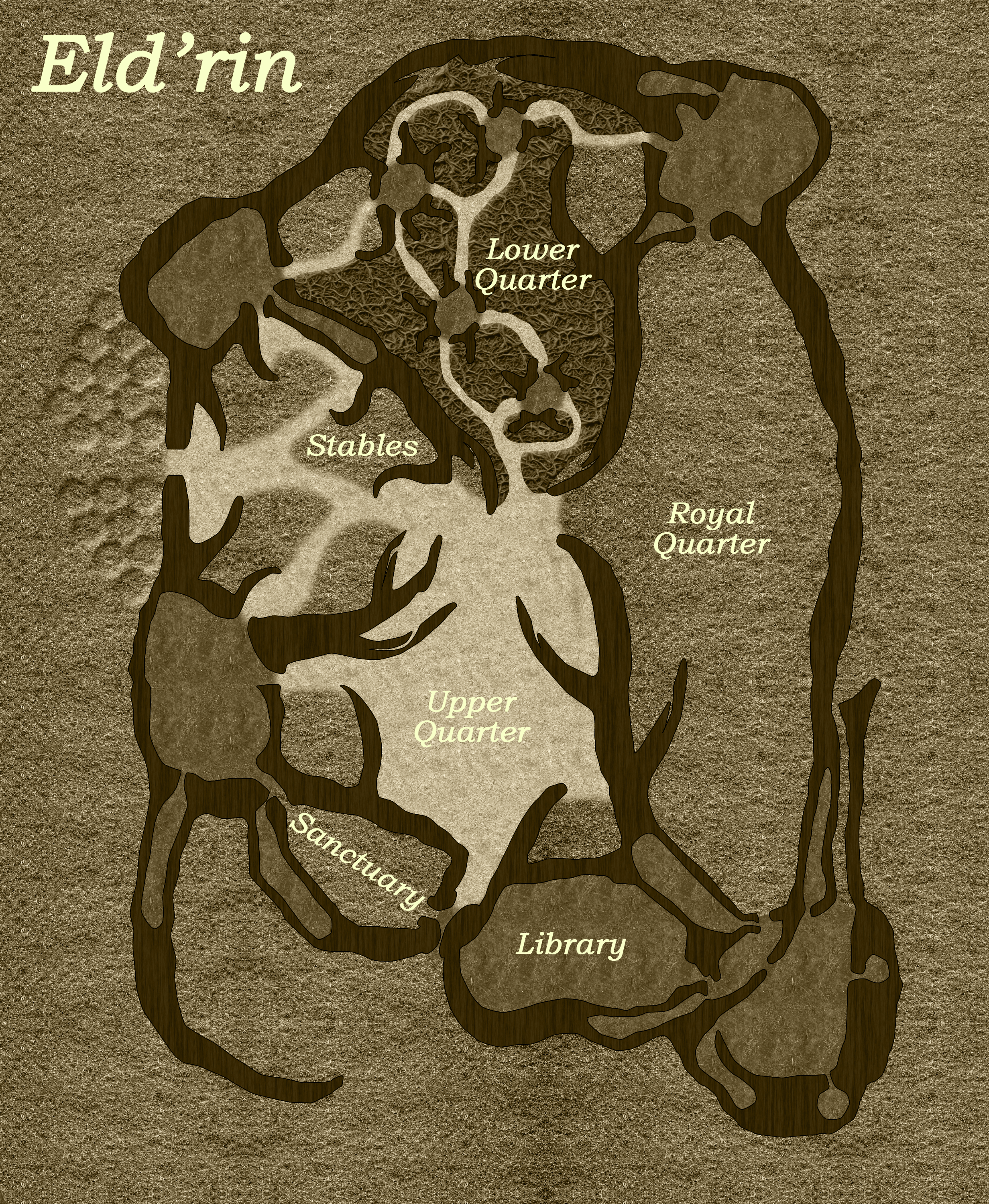
Eld’rin

Right click on the image and view in new tab to see it full size. © T. A. Myron 2019

Eld’rin was formed long ago by elvish mages growing four great trees together. These four trees form the four corners of Eld’rin. Their hollowed out trunks allow access to the upper levels of Eld’rin, although most of the buildings are located below, on the ground.

Eld’rin is divided into four distinct sections: the bailey, or west quadrant, the Royal Quarter, in the east, and the two districts to the north and south. In the north you have the Lower District, so named because it is somewhat lower in elevation than the rest of Eld’rin, thus causing mist and fog to coalesce there in the early morning, sheltered by the leaves of Eld’rin. It is here that most of the elves live. The houses of the Upper Quarter, to the south, are reserved for the wealthy or important, and are much larger than the houses of the Lower Quarter.

Eld’rin has stood for many centuries, and many secrets and forgotten enchantments are riddled into the wood and ground which make it up. Hidden passageways and vaults are everywhere, and dark shadows could hold the secrets to long-forgotten mysteries.

Eld’rin is governed by a council, which oversees the running of the great city. They meet within the upper levels. Residing within the keep in the Royal Quarter is the king of the elves, and his family. He governs matters pertaining to all of the elves, but leaves the day to day matters of Eld’rin to the council.

Glossary

The Ancient Elven Language:

All the races of Feylund; Elves, Dwarves, Men, Vampires, even wolves when it serves their purpose, speak in the common tongue, the language of men, which is used throughout the land. Each race, however, has its own language, though only the dwarves maintain its daily usage. The elves possess such a tongue, and of all the languages, it alone seems to possess some magical quality to it. Birds and beasts will hearken to it, obeying its commands without hesitation, and even plants will bend to its words, though in their own slow time. Why this is, or where the language itself came from, is unknown, even to its keepers, the elves.

Long ago, in the distant past of the First Age of Feylund, the elves adopted the speech of men, along with every other race. What prompted this action or brought it about is well hidden, and it remains a mystery to this day. The elven language serves instead as a more formal means of communication amongst the elves, and the only way for them to speak with the creatures of the world, though those conversations remain one-sided.

Through this language, the elves were long ago granted power over magic. No other language can control magic the way Elvish does, though the reason for this is as uncertain as the origins of the language itself. It was long ago made clear to the Elves that their language alone, however, has no power over magic. Magic is controlled by the mind. Only Elvish, however, can focus the mind to the degree needed.

Most races do not bother to study the words of Elvish, and the Elves themselves are not masters of the language. They are known to make many mistakes in grammar and pronunciation, though their tongue is far more accustomed to its intricacies than that of others. These mistakes sometimes lead to accidental spells or enchantments, but for the most part, the concentration of the mind overrides the meaning of the words.

When performing magic, the elves tend to speak in unclear, broken sentences, just enough to convey the object of their desire. It is likely, however, that the language was meant to be spoken properly and concisely, weaving a spell with every word.

Below are the phrases of Elvish found within this tale. Please be clear that these are not the original lines of the language, but the rough words as they were spoken in the above. Their literal translations are given, but in the event of names, these are often not considered.


Ael – “Sir.” This word simply denotes a title of respect, usually given to those that the speaker is not overly familiar with. The elves have no real word for ‘sir.’

Ans Aras – “Blue Water.” The name of a large river that cuts through the Great Forest, dividing the elves from the wolves. It is spanned by two bridges.

Arath Imil – “My Sanctuary.” The name Eltuthar gave to the home he built for himself upon being banished. It was situated halfway up the mountain Eserien, located in the middle of the Great Forest. It walls and floors are inlaid with many enchantments, and its balcony opens upon a spectacular view of the Great Forest far below, facing east.

Asir im Asriim – “Go back to the elves.”

Athen Selar – “Heal the cut.”

Ensir aniliim ethen ner aser aniliim eld’sudern as’nelikath – “Awake those within if any should enter tonight.” The enchantment Dilmir placed on Ilrin’s home. His wording, while still rough, is far more complete than is usual.

Eser, cirith imil – “Run, my horse.”

Eth Aniliim – “Visioned Ones.” In the ancient language of the elves, many words, such as ‘visioned,’ do not exist in the common tongue. Translated more closely to that language, the phrase would follow better, “those with uncommon sight.”

Fiser’teren, ekcer – “Vines, retract.”

Kelther imir en shenith Alfimiril – “Show me where Alfimir lies.” This particular spell is hard to translate because Elvish treats placement differently than the common tongue. Because of that, a more literal translation could only go so far as, “Show me the place of Alfimir.”

Veneth Lith – “Green Light.” The wording of this spell indicates Dilmir’s distraction at the moment of being cast. Most spells or enchantments state requests of magic, not objects. Dilmir is in fact lucky that anything at all happened.


Complete List of Persons, Places, and Things

Aimim – Dilmir’s aunt. Aimim’s husband joined Eltuthar and was slain when the council attacked him.

Aldir – A young elf who trains in Eld’rin.

Alfimir – Eld’rin’s only archmage. Alfimir at first followed Eltuthar’s teachings, but soon defected to the side of the council.

Aranthar – A powerful elf that created the giants during the Second Age and led them against Eld’rin.

Cyprien Essenwein – Vampire and general of the undead forces on Feylund.

Delthimir the Cursed – The son of Eltuthar.

Eld’rin – The Elvish capital.

Elmir – The elf that trains Dilmir in magic.

Eludir – Dilmir’s grandfather.

Endir – A young elf that dueled with Ilrin when Dilmir was with Eltuthar.

Felmir – Dilmir’s father.

Felnir – One of Eltuthar’s followers.

Great Forest – A vast forest defended by wolves.

Iliadin – The elf that trains Ilrin in magic.

Ilrin – A friend of Dilmir.

Uldir – Dilmir’s other uncle. (He had two)

Chapter Four – To Form a Spell

The next day was announced by a glorious sunrise, etching the few wispy clouds overhead with gold and yellow. Long before the sun rose fully, Dilmir departed his house into the still quiet Eld’rin, low mists covering the ground as he walked. In the half light of dawn, he made his way towards the center of the massive city – the place where four especially long roots, one from each of the four trees, met and tapered into the ground before joining beneath it. Here he selected the broad side of one of these roots and settled himself to wait.

Slowly, the sky grew brighter. The mists retreated to the dark corners, though the place that Dilmir watched was still covered with them. Soon, bobbing towards him through the fast fading darkness, he saw the object of his waiting. Ilrin detached from the mist and came to meet him, her eyes still drowsy. “Morning,” she said, a little vaguely.

Dilmir smiled. He knew she would liven up in a few minutes, as she always did. Together, they made their way towards the massive gate, which unfurled as they approached it, allowing a new day to enter the city.

The ground in front of the city, save for a path leading to the gates, was riddled with small roots coming from the massive trees of Eld’rin. They formed large rings on the ground, the grass within the rings being sunken, forming many small craters. It was within these slightly hollowed out spaces that the mages of Eld’rin taught their pupils of magic, the thing that set the elves apart from the barbaric humans to the North, aside from their features.  

Having trained for two years here already, Ilrin and Dilmir separated, and went to wait for their trainers in their separate fields of grass. Soon, mages and their charges came trickling out of the giant city, and began spreading out over the field. Dilmir soon spotted the mage that had been assigned to him, grudgingly, he was sure, hobbling over the roots towards him. Elmir was an old elf, far older than most of the elves in Eld’rin. It was rumored that he had been alive when Eld’rin had been woven into its present state, many hundreds of years ago. Lines creased his face, sprouting from below his eyes in deep furrows and running throughout his face. His hair, still somehow quite thick, was a frail-looking shade of gray. His angular features, common to all elves, were sharply defined as the sun hit them.

Elmir stalked silently past Dilmir, his face blank, his mouth drawn. He took up a position thirty paces from Dilmir, and then, ignoring the fresh sunlight that poured into his eyes, turned to face him. “Begin,” he said, the single word as flat as his expressionless face.

Dilmir sighed, but closed his eyes and delved deep into his mind, searching for the elusive stream of magic peculiar to all elves. Elmir was an elf of few words. His expression never faltered, and he never gave away his feelings. He had been trained well in his day, and he now sought only to pass his training on to others, although Dilmir, perhaps, had not been whom he had had in mind.

Most elves would have had to hunt for their magic for awhile; part of the training was to help them discover where it was. Dilmir, however, knew exactly where his magic was wherever he went.

Power seethed within him, boiling and frothing, yearning to be let out. At first it had been easy to control, in the years when he first came to Eld’rin, but over time it had grown, he was unsure why, and now he could only keep it in check with his mind. This proved to be easy enough, though distracting at times. When Dilmir was called upon to use his magic, however, he had great difficulty in selecting the proper amount.

He had been careful, for seven years, never to let his power escape him. The elves still remembered the night he had slain the wolves, they didn’t need any reminders. Today, however, was a day Dilmir had been dreading for several months.

Elmir’s voice cut into his thoughts, forcing his eyes open. “Today,” he said, his voice as slow as thick syrup and conveying nothing, “you begin to learn of spells. But first,” he added, “you must be tested. Summon for me a globe of water.”

Dilmir smiled, though very briefly. It was customary for the day to start with a review, and this particular request was a trick. He knew because he had failed at it at least a hundred times before Ilrin had worked it out and told him. Instead of searching through the air for particles of water, as most beginners did, Dilmir knelt, placing a hand on the ground, and extended his magic towards the earth below it. He was careful while he did so, using only the magic that he needed, keeping the rest within himself. Once he encountered the hard-packed ground before him, he directed a steady stream of magic at it, allowing the power to flow into the ground smoothly. As he did so, he focused on the magic, causing it to shape and alter the earth so that it would give up the water below it.

Magic, by its very nature, altered things. It was by this that the elves could sense and use it. They had the power to control it, and the way it changed whatever it touched. The trees of Eld’rin had been grown by such means. Elven mages had long ago sown enchantments of growth into their bark, causing them to become tall and thick.

The ground beneath Dilmir’s palm steadily grew soggier, until a little pool of water formed on top of it. Dilmir then focused his mind on the water, causing it to cling to the magic he laced it with.

Magic was not a mystical force that could not be explained. It was a tangible part of Feylund, as common as the air through which it floated. Magic which the elves had not yet used could sometimes be seen in the dark corners of the Great Forest. A shimmering ball of faint light, a curiously growing branch, all were signs of magic, most of which the elves still did not understand. Only when it was used did magic become passive, submitting itself to the will of its caster.

Satisfied that the water would remain in place, Dilmir carefully slipped his hand beneath it, and picked it up. He glanced up at Elmir. He had done the exercise perfectly.

Elmir’s face could have been compared to a tree with ease. No flicker of surprise, no pleased twitch of the mouth escaped him. “Very good,” he said, his voice once again as flat as the plains to the South. “Now we shall begin on spells. I want you to set the patch of grass before me on fire, and then put it out. But this time, do so from where you stand.”

Dilmir frowned. This wasn’t a spell, this was an enchantment impossible to cast. All elves had to touch what they enchanted, for it was a rule of magic. If they did not, the magic would seep from their palm and float away in the air, free once again.

Elmir’s visage remained impassive, however, so Dilmir stretched out his arm, forming the magic with his mind before releasing it. Once the enchantment was fully completed, Dilmir released it at a piece of grass three paces from Elmir, practically throwing it with his mind. It zoomed forward, a faintly shimmering ball of light in the rays of the young sun, but then dispersed, dissolving into the air.

“The trick,” said Elmir, his face acknowledging nothing, “Is to use energy as well as magic. Infuse one with enough of the other to get it across the intervening space between you and your target.”

Dilmir nodded. It had never occurred to him that spells would simply be enchantments with energy. He had always thought they were some higher form of magic, requiring more power, but he was relieved at their true nature. It was hard enough to keep his power in check.

Concentrating carefully, Dilmir formed the magic at the ends of his fingers. Once the spell was complete, he paused. How much energy should he use? Undecided, he put a large amount into the enchantment, and then released it.

With a loud whoosh, as if a tree branch had cloven the air, a dart of red light leapt from Dilmir’s hand and struck the ground. The place burst into flames instantly, hot, orange, smokeless flames that neither grew nor receded, kept in place by the magic that had created them.

Elmir nodded briefly. “Now put it out,” he said.

Once again, Dilmir formed an enchantment, and once again, he placed the same amount of energy into it. He decided to simply end the flames, rather than douse them with water, as the former would not cause any smoke. As an afterthought he added an enchantment that would cause the grass to grow back.

Concentrating on the dancing flames before him, Dilmir released the magic. At first, he thought nothing had happened. But then, the fire flattened, as if it had been covered with a blanket, and then went out, a ring of blackened grass spreading from its center. In another moment, new grass had pushed aside the burnt blades, and all that was left was a faint patch of ash.

Elmir stood observing the place where, moments before, a fire had been. After nearly a minute, he said, “Very good. Most elves take time to cast their first spells, but you seem to have caught on quickly.”

Dilmir froze. Had he done too well? Had he used more magic than he should have?

If he had, Elmir did not show it. “Very well,” he said, looking once again at Dilmir. “Let us move on to other spells. You will find that they differ from enchantments more than you might expect.”

The day wore on. Elmir did very little other than prompt Dilmir in the right direction; he preferred to have him find things out for himself. Dilmir felt he might learn a little faster if Elmir showed him how to do things, but he remained silent. No elf would criticize their teacher.

By the time the sun climbed to the peak of its path, Dilmir had learned a good number of spells. While enchantments were based on slow and careful focus, spells were based on quick action. That explained why mages always used them in combat; they were fast and required far less focus.

Finally, the mages dismissed their pupils. Dilmir saw, out of the corner of his eye, Ilrin stand by the gate, waiting for him.

After a long scrutiny of the sun – elven eyes were not as easily blinded as those of humans – Elmir remarked tonelessly, “Very well. You may go.”

“As ihr selenar imil, manithar,” muttered Dilmir before turning and hastening towards Ilrin. The phrase was the customary farewell to a teacher.

Ilrin waited until he reached her, and then, together, they turned into the city. Dilmir was already tired from casting spells, but the day was only half over.

Chapter Three – Tales of Darkness

No sinister shape flew before the moon, which now shone bright and clear on the falling waters of the fountain which Ilrin watched with great interest. Dilmir stood a step or two behind her, allowing himself to relax in the cool night air after the day’s constant training. Elves were far hardier than men, and could duel for hours on end, but the process was still incredibly wearing.

Aimim, Dilmir’s aunt, had sent him to show Ilrin about the house while she finished dinner. The two of them had washed the day’s sweat from their faces, and Dilmir had then shown Ilrin the curiously curved rooms of the house, all of which had been grown from a single tree. The entire house, in fact, was a tree, still very much alive, though hollowed in places to form rooms. The center of the tree was gone, so that it formed a wreath, wrapping around a small courtyard filled with young saplings. At the center of this courtyard, a lively spring bubbled from an elegantly grown stump, and splashed down to be absorbed by the wood and sent up once again. Ilrin, who lived in a much smaller house, had never seen anything quite like the spring, and was thoroughly fascinated by it.

After a few more moments of gazing absently into the bubbling water, Ilrin asked without turning around, “How did your aunt get this house?”

Only the large or wealthy families had such large houses as Aimim, though she was neither.

Dilmir paused. The answer was simple, and yet he feared to give it. Guarding his words carefully, he said, “An ancient relative of hers once did the king a great service. This house has been passed down her line as gratitude.”

“Hmm,” said Ilrin, gazing into the spring, unaware of Dilmir’s moment of hesitation. “I wish I had a house this big. It’s so spacious, I feel like I can stretch out properly here.”

“I like your house better,” said Dilmir, after a moment of reflection. Ilrin turned to him in surprise. “This place is too big, it feels empty to me. Your house is a lot closer together; it feels more like there’s something there.”

“You mean it’s a lot smaller,” said Ilrin, turning back to the fountain with a smile.

“No,” said Dilmir hurriedly, “It just feels… better.”

Ilrin turned back to him, but at that moment, Aimim thrust her head out of one of the four doorways leading into the courtyard, and announced that dinner was ready. Soon afterwards, they were seated around the large table – growing from the floor, as did nearly all the rest of the furniture – eating a hearty meal of food that can only be found on Feylund.

“It makes no sense,” Aimim was saying, “children separated from their families at the absurd age of ten, and then taken far away to train. It seems to me they would do far better with their families watching. Wouldn’t you agree?” she asked suddenly of Ilrin.

“Oh,” said Ilrin, taken by surprise, “I don’t know, I think they do fine.”

“Yes, but your family is here,” persisted Aimim. “Most others must make a new home when they come here.”

“My parents usually don’t watch me while I train,” said Ilrin, “I think I’d do far worse if they did, knowing that they were there. What I don’t like,” continued Ilrin, before Aimim could reply, “is how the Dark Elves keep watching us.”

Dilmir remembered the solitary elf dressed in black, standing at the edge of the training field. He hadn’t moved a muscle but his eyes for nearly five hours.

“What do you mean?” asked Aimim. “They were there again?”

“Just one this time,” answered Dilmir. “They’re trying to recruit again, aren’t they?”

“I don’t know that they ever stopped,” sighed Aimim. “But I wish Eltuthar would stop sending them.”

“I thought Sonlen killed him, Eltuthar,” said Ilrin glancing up.

“Oh no,” said Aimim, “he left him alive, he was bound to do so by the council, but he broke him. I wouldn’t have been surprised if he had killed him anyway though, after all that he did. Families torn apart, trees in flames, blood in the rivers; and all because of his endless thirst for power. We’re well rid of him.”

“His elves seem well enough though,” said Ilrin. “Well,” she added, at a look from Dilmir, “I mean they just stand there, watching. They never do anything.” Ilrin looked up ponderously at the ceiling for a moment, as if trying to remember something. “Although,” she said slowly, “he did seem more interested in our duels than anyone else’s.”

Dilmir hastily looked down at his food. He had hoped that she hadn’t noticed that small detail.

“Really?” asked Aimim, looking up, “Why?”

Dilmir looked up at his aunt, trying to catch her eye, but she was watching Ilrin. Ilrin, however, merely shrugged and continued eating.

“I don’t see why they would want to watch us, though,” Ilrin continued, having swallowed. “I thought they only recruited those that have completed their training.”

“They seem to be going after younger and younger elves these days,” agreed Aimim. “I suppose the younger the elf, the better what they have to offer sounds.”

“What’s that?” asked Ilrin, unaware of Dilmir’s renewed attempts to attract the attention of his aunt.

“Oh, they promise power to whoever will listen,” said Aimim vaguely. “Not openly of course, the king would never allow it. They get elves by themselves and talk them into joining them.”

Ilrin frowned. “But,” she said, ponderously suspending a piece of meat in the air with her fork, “there must be something to what they say, otherwise the elves would come back, wouldn’t they?”

“Eltuthar the Black was a powerful mage. I’m sure he has a few tricks that he can show them, even if he can’t use them himself anymore.”

“What exactly did Sonlen do to him?” asked Ilrin. Across the table, unnoticed, Dilmir fidgeted uncomfortably. Ilrin seemed far too curious about these things.

“Only he knows,” replied Aimim with a shrug. “Though I’ve heard tell it was some sort of powerful curse.”

A silence fell over the table, while Ilrin ate slowly, clearly thinking. “I wonder,” she said, half to herself, after a minute or two. “Do you think he’ll ever try to come back, Eltuthar I mean?”

“Come back? I doubt he can,” said Aimim. “He’s had enough followers for a long time now though; if he were going to try anything, I think he would have done it long ago. He didn’t dare do anything while Sonlen was still lived, but he’s been dead for over thirty years now.”

“There’s still Alfimir,” said Ilrin.

Aimim sniffed. “Yes, but he’s not nearly as powerful as Sonlen ever was. If Alfimir ever encountered the full power of Eltuthar the Black, I doubt he would last a second.” Her expression had suddenly darkened as she said Alfimir’s name, and Ilrin looked momentarily startled at her look.

Deciding that the time had come at last for a change of topic, Dilmir said, “Have you seen Ilrin train, aunt?”

Aimim’s expression cleared almost at once. “No,” she said, “I really should watch sometime soon. If you’re half as good as he says you are,” she said, turning to Ilrin, “it ought to be quite a sight.”

Ilrin laughed, nearly as grateful at the change of topic as was Dilmir. “He’s been improving a lot,” she said to Aimim. “He nearly beat me today.”

Dilmir thought this was a bit of an overstatement, but made no comment on the remark. Instead, he said, “Just you wait, Ilrin. I really will beat you tomorrow.” They both laughed, neither knowing just what tomorrow would bring.

Chapter Two – The Way of a Blade

Dilmir whirled around, and saw the shining edge of a blade descending rapidly towards his head. He frantically brought his sword up to meet it, but at the last moment, the blade twisted, as if alive, and snaked under his guard. Dilmir tried to duck under it and block it with his sword at the same time, lost his balance, and fell to the ground.

Every inch of Dilmir’s body ached. Bruises covered his arms and legs, and his muscles were sore from hours of combat. The training of an elf was rigorous, to say the least.

Dilmir took a moment to catch his breath, lying face down on the hard-packed earth of the training field. His sword arm felt as though it were encased in heavy metal, and the sword that he held felt equally heavy.

Placing his hands on the ground, Dilmir raised himself to his feet. He wiped some sweat from his eyes, and flicked his sword into a defensive position. He bent his knees slightly, ready to spring in any direction at a moment’s notice. Only then did he raise his eyes to his opponent.

She stood a short distance away, surveying him placidly through a face that conveyed nothing. But then, every elf was trained to hide their emotions behind such a mask. Ilrin was far more adept at it than Dilmir was, however.

Dilmir watched her, waiting for her to strike, hoping that his face conveyed as little as hers did. He had learned long ago that to attack Ilrin was a sure way to defeat, it was far better to let her strike first. Of course, Dilmir was sure she would win either way; Ilrin seemed to be a natural expert with the sword.

Without the slightest of warnings, Ilrin suddenly darted forward, her blade seeking an unprotected spot near Dilmir’s left shoulder. Dilmir spun towards his right quickly, hoping to avoid the blade, but at the last moment, Ilrin spun around so that her sword came at him from the other side. Dilmir stopped himself just before he collided with the thin blade of metal, but Ilrin was too fast. With a deft movement, she flicked her sword sideways and brought it to rest, quivering an inch from Dilmir’s throat.

Dilmir stepped back as Ilrin lowered her sword. The result was always the same, Ilrin always won; Dilmir was lucky if he managed to escape her first attack. Nonetheless, after a moment he raised his sword to a different position, and waited for her to attack again.

Before she could, however, a voice interrupted Dilmir’s concentration. “Dilmir,” it said, as its owner, a much older elf, stepped between them, “you are merely reacting to what Ilrin does. That’s why she always defeats you so easily. All she has to do is feint in one direction, and then attack in another. You have to stay out of her way, but you also have to watch every other angle. Don’t let her catch you by surprise.” The trainer’s voice was oddly harsh, unlike the normal speech of an elf, and his brow darkened as he spoke to Dilmir.

Dilmir nodded, though he did not turn his head, and brought his sword up again. Their trainer was right; once Ilrin attacked, Dilmir focused on getting away, leaving everything else unprotected. He fixed his eyes on Ilrin, waiting for her to attack, but she kept her sword lowered.

“You’re doing better though,” she said, speaking directly to Dilmir. “A few weeks ago I wouldn’t have needed to feint.” Dilmir smiled briefly to himself. That was Ilrin, always confident that he had improved since their last bout. “I know you can beat me,” continued Ilrin, “you already have once.”

“You know that was because I lost my balance and happened to fall in the right direction,” said Dilmir.

Ilrin chose to ignore this. “All you have to do is watch my sword,” she said. “It will tell you where it’s going to go next.”

Dilmir raised an eyebrow at her, but quickly saw that she was serious; she really did believe that he could beat her. He chose not to answer, but tightened his grip on his sword, keeping his eyes fixed on Ilrin’s blade. Ilrin flicked her own sword up and remained motionless, watching him, her eyes, which were a curious shade of brown, darting from place to place.

She took longer than usual, something that Dilmir could only interpret as a good sign, for it meant that she hadn’t yet found an unprotected point to attack. His grip was just beginning to relax slightly on his sword hilt, when she suddenly leapt forward, her eyes fixed on some place near Dilmir’s right arm.

Dilmir twitched out of the way, but kept his eyes on Ilrin’s sword. Just before it reached the place where he had been, he saw it twist slightly to the left. He ducked just in time; the sword went flying by where his head had been, and he thought he felt a few hairs detach themselves from his head.

He flipped half way over, trusting his feet to find their footing, and saw Ilrin’s sword slicing through the air towards him. A sudden idea occurring to Dilmir, he spun downwards so that his sword flipped up and blocked Ilrin’s. It seemed a good idea at first, but then Ilrin twisted her own blade about Dilmir’s, wrenching it from his grasp and sending it flying off to the right. A moment later, her sword tip found his unprotected neck once again.

Dilmir, still attempting to figure out what had happened, backed out of his awkward position and went to retrieve his sword. It had landed, as it turned out, near the feet of another pair of viciously dueling elves, their blades flashing in and out, their feet churning up small clouds of dust as they leapt and dodged in a mesmerizing dance.

Dilmir waited for them to stop – which they did as one defeated the other in a spectacular skyward leap and a downward jab of his blade – before approaching his sword. As he bent low to pick it up, the elf nearest him drew away as though he were something contagious, and turned his back on him. Dilmir grabbed the hilt of his blade, and, studiously ignoring the elf’s reaction to him, turned and walked back to where Ilrin stood waiting for him. A small bubble of resentment at the elf filled Dilmir as he walked, but he kept his face composed. He should be used to their reaction by now.

Ilrin frowned slightly at the elf as Dilmir approached, but soon smoothed her face and turned to Dilmir.

“I knew you could do it,” she said. “All you have to do is watch my sword.”

“She’s right,” said the trainer, coming between them once again. “Watch her sword, and strike when you see an opening. Perhaps you can defeat her yet.” His voice, however, was skeptical.

“Of course he can,” said Ilrin, a barely detectable tone of exasperation at the trainer coloring her voice for a moment.

Dilmir couldn’t help the smile that came to him, but quickly rearranged his face into something blanker, and faced Ilrin. They both raised their swords. To the right, the two elves next to them clashed once again, but Dilmir did not move. To lose his concentration was to lose the battle.

Ilrin struck quickly this time, so quickly that she caught Dilmir by surprise. He barely had enough time to get out of the way before she turned, and was coming at him again. Desperate to get away from her sword, he somersaulted backwards out of the way, coming up with his feet planted, and his sword ready to ward off any blow. She paused, and then took a step back, raising her own sword. Once again, her eyes darted all over Dilmir, seeking some way past his guard.

A moment later, she leapt forward, her blade gracefully slicing through the air towards him. Dilmir swerved to the right, but instead of falling back, leapt to one side, bringing his blade down towards Ilrin’s now unprotected back as she leapt past him.

She flipped over in midair so that she faced him, and met his sword much the same way he had met hers but a minute ago. Dilmir tried to disarm her the same way, but Ilrin released her sword and grabbed it with her other hand, the sudden loss of resistance causing Dilmir to lose his own sword. She then landed in front of him, her blade pointing, once again, at his throat.

This time, however, as Dilmir again drew away, he saw that she too was breathing heavily. That was definitely a first. Ilrin dropped her sword point to the ground, trying to catch her breath, though her face was still smoothly composed, and Dilmir turned around to collect his own blade, which had fallen behind him.

As he did so, he glanced towards the edge of the training field. Dark was falling quickly through the air. The sun had already slipped below the far distant mountains to the west, painting the horizon a vivid hue of orange, and lining the scattered clouds in pink. To the east, the sky was already a dark blue, though the first of the stars had yet to show themselves.

What drew Dilmir’s gaze, however, as he stooped to collect his sword, was a solitary figure standing on the border of the training field. He was dressed in black, save for his head, which was bare. His face, beneath his light brown hair, looked young; he couldn’t have been far past twenty. Though it was now impossible to discern in the gathering dusk, Dilmir knew what symbol was etched in red on the front of his leather armor, for he had stood there for half the day already.

The elf stood, as he had for the past few hours, arms folded, surveying the duelers silently through his dark eyes, the only part of him that moved. As Dilmir watched, catching his breath, he was sure that those eyes flickered towards him more than once.

He turned around just as the trainer glanced up at the sky, as if he had only just noticed its darkening hue. “I think that will be all for today,” he said. “You had both better go home. I’ll meet you here again tomorrow.”

Without another word, Ilrin and Dilmir sheathed their swords and turned towards the last vestiges of sunlight. The elf, still standing on the edge of the field, smoothly drew into the shadows when he saw them coming, his figure fading into the blackness. As they walked, Dilmir felt rather than saw Ilrin draw a little closer to him.

However, they passed the place where the elf had been without incident, and, turning a corner, continued on their way. “Don’t forget you’re invited to dinner, Ilrin,” said Dilmir as they walked. “My aunt would be furious if you were late.” Ilrin laughed. They both knew that Dilmir’s aunt, still young by elven standards, found it exceedingly difficult to be furious with anyone. “I can show you around the house before we eat, if you want,” added Dilmir.

Ilrin nodded. “Yes,” she said, “I’ve always wanted to see the inside of one of those houses. A comfortable silence fell between them, as Dilmir glanced up and saw a large full moon overhead, its perfect circle of light unblemished.

On their right rose a dark wall, a solid expanse of rough bark, rising smoothly from the ground in the rapidly falling darkness, despite the full moon. Several roots stuck out from the base of the giant tree, but they were worn to the ground where Ilrin and Dilmir had to pass.

This tree, as it so happened, was one of four, each capable of encompassing a dragon easily within their hollow innards. Their roots and branches, grown and twisted magically by the elves that lived between them, connected with each other, forming four long and immensely thick walls. The higher branches of the trees curved elegantly upward to meet in the middle, casting a shade of leaves over the great elven capital of Eld’rin, which was cradled beneath them.

The ground was fairly flat, and Dilmir and Ilrin soon reached the great gate into Eld’rin: a latticework of branches that, when closed, formed an impenetrable barrier. Only when they entered the long window of light pouring from the gate did they see that many of the other trainees had walked with them, unseen in the dark, towards the same destination.

Dilmir felt himself stiffen slightly as the other elves appeared around him, and quickened his pace, hurrying through the gate. Before him, an even greater throng of elves awaited, all milling about in the last minutes before the gate was closed. He instinctively turned right, heading into one of the giant trees that formed the corners of Eld’rin.

Behind him, Ilrin paused for a fraction of a second, looking between him and the multitude of elves, and then hastened to catch up with him. “Why do you do that, Dilmir?” she asked, falling into step beside him.

“What?” he asked, innocently enough, though he knew perfectly well what she meant.

“Why do you avoid them like that?”

Dilmir did not reply immediately, but continued walking. At last, he said, “You know I tried, Ilrin, but what use is there now? I can’t change what they think.”

Ilrin was silent for a moment, but then said, quietly, “I know how they treat you, but people change. You told me that yourself years ago. They won’t change their minds about you if give up now, though.”

“I’m not giving up,” said Dilmir, “I’m just…” He stopped. “I thought they would change too, Ilrin, but it isn’t working.”

It was true. Since the day he had come to Eld’rin, the elves had treated him as something to be avoided, a strange creature in their midst. He knew why they did so. When he was ten, he had been taken from his village to be trained here for nine years. On his way, they had spent one night in the forest, and on that one night, the camp had been set upon by wolves. Dilmir had lost count of the times he had wished that had never happened. If the wolves had left them alone, he would have never discovered the strange power that he possessed, that neither he nor any other elf could explain. But they had attacked, and before he knew fully what had happened, he had slain three of them, how, he knew not.

Though he had never used his power since, the elves had not forgotten that one night. The fact that he had power they did not alone meant nothing, but he knew the true reason they treated him as they did. Only Ilrin seemed to understand that he wanted nothing more than to be a normal elf.

“It will work,” said Ilrin simply. “I know it will. You just have to give them more time.”

Despite his thoughts, Dilmir smiled to himself. He knew she would never give up on him.

As the two of them walked through the hollow tree towards a forest of wide trunks, which were in reality the elves’ houses, darkness fell outside, beyond the walls of Eld’rin, casting everything into a great shadow.

In a moment, however, one of these shadows detached itself, and stared for a long while at the gate, as the branches slowly unfurled and wound themselves together, thorns sprouting along them to keep out intruders.

He had arrived too late. The elf drew back into the shadows. He was not the same elf that had watched Dilmir train; this one was far older, and wore a thin traveling cloak, dyed a mottled green to blend in with the forest. He couldn’t enter the city now, lest he be discovered. He would have to wait until morning. He must warn Dilmir.

Chapter One – The Council

“He is too powerful!” These words were spoken by an elf, who accompanied them by slamming his fist onto the wooden table before him. If this had been any ordinary table, it doubtless would have swayed under the force of the blow, but it did not. It was a marvelous thing, connected to the floor by a flowing stalk of wood which grew seamlessly into it.

“We are well aware of that fact,” said an elderly elf, placidly surveying the one who had spoken over the tips of his fingers, which were placed together. This elf’s hair was streaked with gray, leaving the rest white, but very few lines were to be seen on his skin. By human standards, he looked no older than forty. “However,” he said, his expression changing not at all, “that is no reason for what you suggest. It is how Dilmir would use his power that should be questioned.

“Many of the council you see here before you have had ample opportunity to observe Dilmir. We all agree that he is powerful, and yet he does not use his power. What would you suggest, Eldin? Are we to act on assumptions?”

Eldin mouthed silently at the old elf, as if not able to believe his reasoning, and then turned and walked the length of the room. The room was as marvelously crafted as the table. The walls and ceiling flowed perfectly into each other, giving the room the shape of an overly stretched egg, though from the inside. Windows were set into the walls at regular intervals, though no glass could be seen in them. Instead, enchantments hovered within their frames, invisible save for the edges, which glowed a faint hue of blue.

Eldin placed his palms on one of these window frames and looked out, his mind not seeing what lay before him. At last, he turned, and faced the council. “How many of you remember the dark days?” he said, his voice back to its normal volume.

None of the thirteen elves that made up the council answered. They sat in their chairs – which were also grown from the floor – and watched him as he began to pace around the table.

“Doubtless, all of you do,” said Eldin, answering his own question. “I, for one, remember them most vividly. Families were torn apart, sons and daughters left the homes of their parents, and anger was everywhere. Bloodshed was inevitable, and brother was pitched against brother in the battles that came. Sorrow swept all of Feylund, and all of it due to the actions of one elf: Eltuthar the Black.” Eldin spoke this name with such venomous hatred that the elf nearest him actually shifted away from him in his chair, his eyes fixed on the elf’s face. Eldin did not notice, but continued.

“Eltuthar, as I am sure you know, first showed signs of his unnatural power when he was but twelve. We did nothing, and war and misery followed. Dilmir has shown his power at the age of ten, and yet you say you still will do nothing?”

“Are you saying Dilmir will follow in the steps of Eltuthar?” asked one of the council sharply.

“I do not know,” replied Eldin, leaning on the table and looking at the elf. “Likely not, but his power cannot bode well for the elves.”

“You come before us,” said the elderly elf, “and ask us to take action with no reason.”

“Would you rather wait for a reason to act?” asked Eldin, rising from the table, “or act now, and prevent such a reason ever arising?”

“The fact remains,” said the old elf, “Dilmir has not shown his power since that night before he came here. He was attacked by wolves, the whole party was. Many young elves can show power that they do not know they have when something of that nature occurs.”

“Yes, but during that night,” hissed Eldin, “he was said to have killed three wolves without even trying. No other elf has ever done that at the age of ten, not even Eltuthar.”

“What would you have us do?” asked another elf, nearer Eldin, “defend the wolves? Dilmir has done nothing, and until he gives us sufficient reason, we can take no action.”

“He is hiding his power, hoping that you will forget. You must see this!” When the other elves did not reply, Eldin continued, a note of pleading entering his voice. “You cannot just sit here and do nothing,” he said, quietly.

“Indeed, Eldin, that is precisely what we must do.” The old elf leaned forward, his long hair falling forward to frame his face. He glanced up. “We have heard your concerns, Eldin,” he said, “and we have made our decision. Unless you have another topic to bring before us, the council is dismissed.”

“I have but the one topic,” said Eldin, “but you must see that —”   

“Then the council is dismissed,” said the elderly elf, speaking over Eldin.

Eldin stared at the elf for a moment, and then, muttering beneath his breath, turned, and left the room. The other members of the council filed out slowly after him, until only the old elf and one other was left. This other sat at the opposite end of the table, a hood drawn over his head so that his face was cast in shadow. He, unlike the other elves that had just left, wore several pieces of leather armor, all black or dark green. A mottled cloak was clasped at his throat, its folds flowing over his shoulders and down his back, to land on the floor in dark folds.

The old elf, once all the others had gone, rested his elbows on the table and lowered his head into his hands, his eyes closed. After a moment of silence, he said, speaking to the table, “You know he’s right.” His voice was no longer strong as it had been when he had spoken to Eldin, but tired, defeated.

The hooded elf nodded, not moving from his chair. His hood rustled faintly as it moved, and then was still. “Why did you not take his side?” he asked. His voice barely warmed the room; cold and powerfully calculating, and with a hint of smoothness that could not quite escape it, though at the moment it was curious.

The elf raised his head. “I said why, Alfimir. We have nothing against him. It would not do for Eldin to know, but I, too, believe Dilmir is hiding his power, trying to make us forget. Unfortunately, he’s doing a very good job. We cannot act without a reason.”

Alfimir nodded, and lowered his head, as if considering. “If I were to, perhaps, provide a reason,” he said, slowly, not raising his head. He left the sentence hanging.

“That would be all we would need,” replied the elf, watching the dark form of Alfimir. “But there would have to be witnesses. We’ve never sentenced anyone without a witness before, and if we were to start now, some may grow suspicious.” Alfimir nodded. “I will be sure there are witnesses,” he said softly, raising his head, though his eyes looked past the elf. Silently, he rose from his chair and swept from the room, leaving in his wake a sense of sinister foreboding. 

Introduction

Aseleth, one and all! Greetings! Most of you have heard me talk about Dilmir at one point or another, so you should have a general idea of what it is. For those who don’t, this is a tale centered on the elves of Feylund, and their magic.

I removed Dilmir and its sequels from Heroscapers.com for two reasons: firstly, because I believed I would draw on them to create my novels (which I now know is no longer the case), and secondly because the theme of the books turned out to be wrong. It is for this second reason that I do not currently intend to repost the two sequels to Dilmir. I can repost Dilmir because the theme had yet to emerge in it; things only came to a head in the next two tales.

Another reason I am reposting Dilmir is because I have referred to it multiple times, and it is unfair to do so while the majority of my readers have never seen it. Also, while far from perfect, I feel that Dilmir does excel in some areas of writing, such as character development and plot escalation, and I would like input on those areas from the other accomplished authors on this site. Break it down.

Now for the warnings. Dilmir was written right when I was discovering development for writing, and starting to take writing far more seriously than I had ever done before. While certain aspects of Dilmir are far better than they have any right to be, other aspects are not.

Fair warning: this tale contains fantasy tropes and clichés. The elves in this tale are based on LotR/Eragon style elves, although I did make some pronounced changes. Also, the combat in this tale, which occurs frequently, is related in its entirety, blow by blow. It had not yet occurred to me that such a form of telling is hard to follow.

That being said, I have not fixed any of these things in this reposting. I have opted to keep Dilmir in its original form. The only changes I have made are fixes to typos and grammar.

Now it is time for me to stop talking and you to start reading. Please enjoy the tale of Dilmir, and don’t forget to offer criticism. It’s what make my writing better.